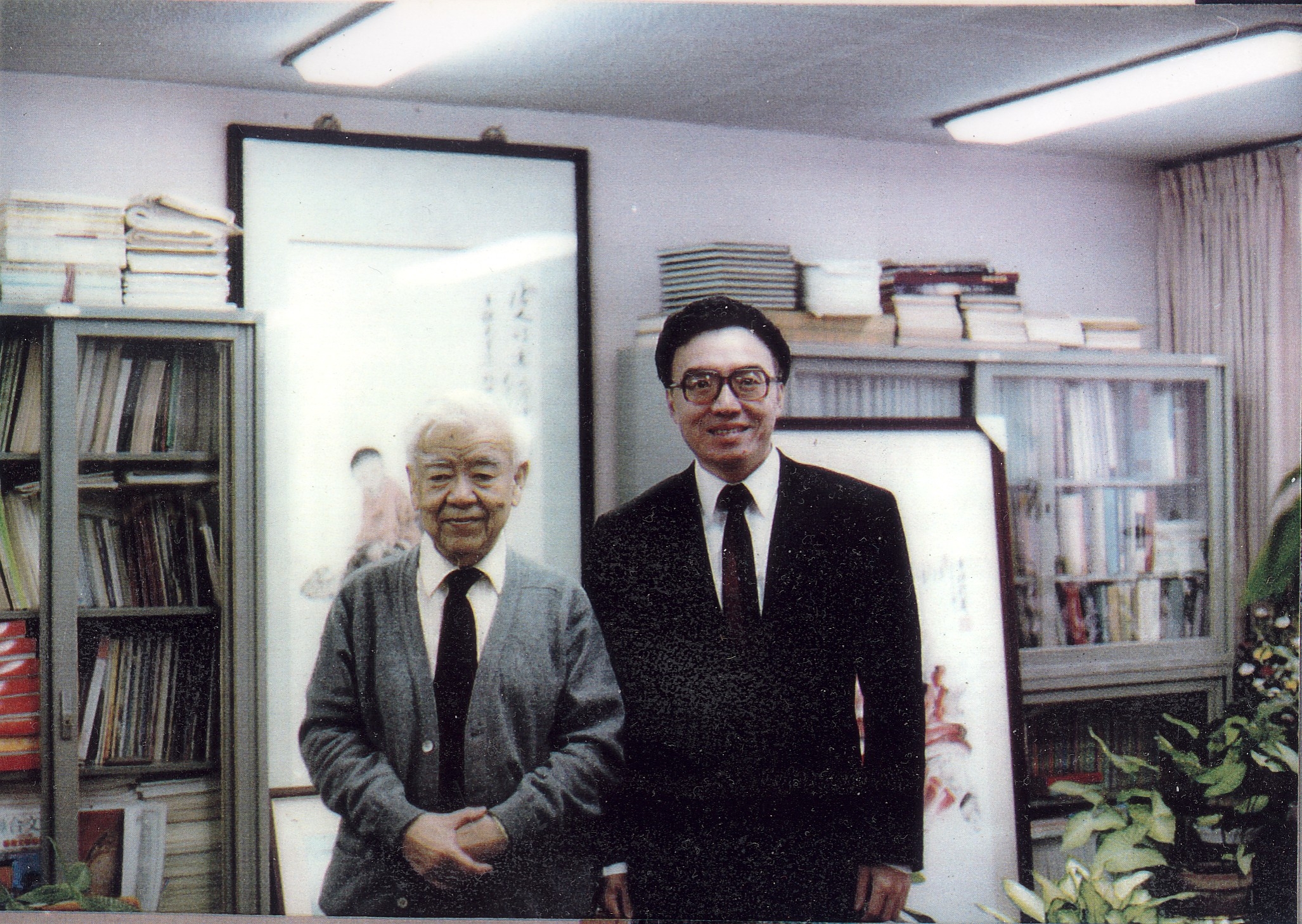
Just one day before he passed away, Ta-You Wu gave a press release in which he mentioned
four notable students, one of whom was Hugh Ching, the Founder of Post-Science Institute (and
the others were his two famous Nobel Prize winning students Yang and Lee and Paul Lee, who
was at his bedside). The WuKuniiChing Team, which consisted of Wu Ta-You, T. L. Kunii, and
Hugh Ching did the (robot) touch research leading to the discovery of the concept of jumpulse, a
sudden change of force (as impulse is a sudden change of momentum). The solution to touch is
missed by Isaac Newton and all the scientists since Newton. Jumpulse kicks off the Post-Science
Knowledge Revolution, and post-science, thus, rises on the shoulder of a scientific giant. Jumpulse also explains ball control, which is the ability of a player to keep a ball on the racket for a prolonged period of time and is the secret of consistency in sports. Post-science deals with knowledge beyond science, namely, social science and life or computer science. Technically, post-science has contributed mainly the solutions to touch, value, and complete automation, which characterizes life (http://post-science.com). The solution to touch is necessary to create Self-manufactured General Purpose Robots which can replace all human physical labors. Today, without robots, humans are used as robots in manufacturing and physical work where the ability of touch is required. Because touch is intimately connected to the design of robot or life, it qualifies as one of the main fields in post-science, even though it is still in the field of science. Furthermore, touch could be one of the most subtle problems in robotics or even in physics or science. Accordingly, a robot should be defined as an intelligent machine that can touch or that can come safely into contact with an uncontrolled environment. For example, if bounceless cars can be built (i.e. cars which can be driven on natural roads), we would not need to spend trillions of dollars to build perfectly flat roads (i.e. controlled environments). Post-Science Institute nominates Ta-You Wu to be a candidate for The Father of Robotics, and the unit of jumpulse to be wu (weight unit) where one wu equals one newton.
Wu's Paper Introducing Jumpulse